Amusing Flash page parodying the ethnically questionable characters from the most recent Star Wars trilogy:
http://www.flakmag.com/flash/swdvd.html

Most Violent Countries
September 21, 2005
Scotland tops list of world's most violent countries
By Katrina Tweedie
Times Online
September 19, 2005
A UNITED Nations report has labelled Scotland the most violent country in the developed world, with people three times more likely to be assaulted than in America.
England and Wales recorded the second highest number of violent assaults while Northern Ireland recorded the fewest.
The study, based on telephone interviews with victims of crime in 21 countries, found that more than 2,000 Scots were attacked every week, almost ten times the official police figures. They include non-sexual crimes of violence and serious assaults.
Violent crime has doubled in Scotland over the past 20 years and levels, per head of population, are now comparable with cities such as Rio de Janeiro, Johannesburg and Tbilisi.
The attacks have been fuelled by a "booze and blades" culture in the west of Scotland which has claimed more than 160 lives over the past five years. Since January there have been 13 murders, 145 attempted murders and 1,100 serious assaults involving knives in the west of Scotland. The problem is made worse by sectarian violence, with hospitals reporting higher admissions following Old Firm matches.
David Ritchie, an accident and emergency consultant at Glasgow's Victoria Infirmary, said that the figures were a national disgrace. "I am embarrassed as a Scot that we are seeing this level of violence. Politicians must do something about this problem. This is a serious public health issue. Violence is a cancer in this part of the world," he said.
Detective Chief Superintendent John Carnochan, head of the Strathclyde Police's violence reduction unit, said the problem was chronic and restricting access to drink and limiting the sale of knives would at least reduce the problem.
The study, by the UN's crime research institute, found that 3 per cent of Scots had been victims of assault compared with 1.2 per cent in America and just 0.1 per cent in Japan, 0.2 per cent in Italy and 0.8 per cent in Austria. In England and Wales the figure was 2.8 per cent.
Scotland was eighth for total crime, 13th for property crime, 12th for robbery and 14th for sexual assault. New Zealand had the most property crimes and sexual assaults, while Poland had the most robberies.
Chief Constable Peter Wilson, president of the Association of Chief Police Officers in Scotland, questioned the figures. "It must be near impossible to compare assault figures from one country to the next based on phone calls," he said.
"We have been doing extensive research into violent crime in Scotland for some years now and this has shown that in the vast majority of cases, victims of violent crime are known to each other. We do accept, however, that, despite your chances of being a victim of assault being low in Scotland, a problem does exist."
Link
Argentinean Italians Are Mostly Southern
September 9, 2005
Migration from Southern Italy to Argentina: Calabrians and Sicilians (1880-1930)
Cacopardo et al. (1990)
Studi Emigr
ABSTRACT: The study analyzes Italian emigration to Argentina from Sicily and Calabria between 1880-1930, compared with out-migration flows from Piedmont. The concepts of cultural patrimony and of migratory strategy are used to measure the different potentials and job opportunities in the Argentinean labor market as well as in the Italian context for those returning home. Considering the high proportion of returnees, a positive or negative correlation between region of origin and of destination can be proposed. Southern Italians indicate a more permanent settlement. The authors conclude that the Argentinean society in its Italian component is the result of Southern rather than Northern influences.
Link
Here are some photos of the Calabrian community in Argentina (click to enlarge):


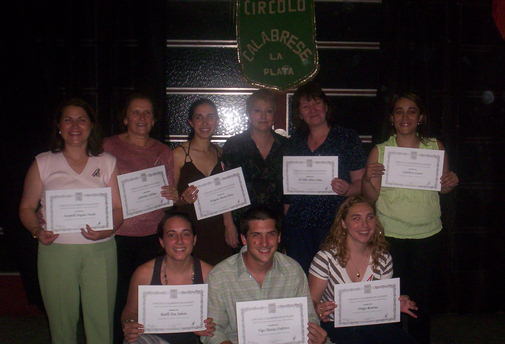


Source
More on the King Tut Reconstructions
September 1, 2005
We've seen the recent French reconstruction of King Tut. Now let's compare it to the Egyptian and American ones done at the same time, the latter with no prior knowledge of the race or identity of the individual being reconstructed. They're the first ever Tut reconstructions based on CT scans of his mummy, and therefore considered to be the most accurate to date.
Egyptologist Dr. Zahi Hawass notes that "The results of the three teams were identical or very similar in the basic shape of the face, the size, shape and setting of the eyes, and the proportion of the skull." All three teams identify Tut as a Caucasoid North African, and Hawass remarks on the striking resemblance their models bear to ancient portraits of the boy pharaoh.
[ click images to enlarge ]


French Reconstruction


Egyptian Reconstruction


American "Blind" Reconstruction
French:
- Jean-Noël Vignal, forensic expert, Institut de Recherche Criminelle de la Gendarmerie Nationale, Paris
- Elisabeth Daynes, anthropological sculptor, Atelier Daynes, Paris
Egyptian:
- Khaled Elsaid, biomedical engineer and team leader
American:
- Susan Antón, physical anthropologist, New York University, New York City
- Michael Anderson, forensic sculptor, Yale Peabody Museum, New Haven, Connecticut
Egyptologist Dr. Zahi Hawass notes that "The results of the three teams were identical or very similar in the basic shape of the face, the size, shape and setting of the eyes, and the proportion of the skull." All three teams identify Tut as a Caucasoid North African, and Hawass remarks on the striking resemblance their models bear to ancient portraits of the boy pharaoh.


French Reconstruction


Egyptian Reconstruction


American "Blind" Reconstruction
RECONSTRUCTION TEAMS
French:
- Jean-Noël Vignal, forensic expert, Institut de Recherche Criminelle de la Gendarmerie Nationale, Paris
- Elisabeth Daynes, anthropological sculptor, Atelier Daynes, Paris
Egyptian:
- Khaled Elsaid, biomedical engineer and team leader
American:
- Susan Antón, physical anthropologist, New York University, New York City
- Michael Anderson, forensic sculptor, Yale Peabody Museum, New Haven, Connecticut
Guns, Germs & Steel on PBS
August 12, 2005
PBS just aired a three-part documentary based on Jared Diamond's best-selling book Guns, Germs, and Steel, which outlines the role geography has played in shaping human history. You should try to catch it in reruns because it's very thought-provoking. But if you can't, there's a lot of information available at the show's website, including detailed summaries, full transcripts and a neat section called "The World" that analyzes global climates and resources by continent.
More
More
More
Episode One: Out of Eden
Diamond believes the blueprint for global inequality lies within the land itself, its crops and animals. [...] [He] realized that the development of successful and productive farming, starting nearly 12,000 years ago in the Fertile Crescent, was the critical turning point in the origins of global inequality. From this point on, one group of people — the natives of Eurasia — would have a head start on the path to civilization.
Successful farming provides a food surplus, and allows some people to leave the farm behind and develop specialized skills — such as metal-working, writing, trade, politics, and war-making. Plus, the simple geography of the continent of Eurasia — one coherent landmass spread on an east-west axis, with universal latitudes and climates — allowed these technologies and ideas to spread beyond the Middle East with ease.
More
Episode Two: Conquest
So, when presented with a copy of the Bible on November 16th, 1532, Atahuallpa throws the alien object to the floor, prompting a furious and surprise attack from the conquistadors. The combined impact of mounted troops, gunpowder and sharpened steel lead to a massacre, and Atahuallpa is personally seized by Pizarro himself.
In a matter of hours, the Inca Empire lies in ruins. But the story of Eurasian triumph isn't over. [...] Native Americans fell victim to European germs — infections which they had never encountered before. And Diamond realizes that European diseases like smallpox were a fatal inheritance of thousands of years of mammal domestication — the lethal gift of livestock.
More
Episode Three: Into the Tropics
As the settlers traveled further north, life suddenly became a lot harder. The foundations of their success, their crops and animals, refused to grow. They were forced to barter for food from their neighbours. And they started to fall ill with a mysterious and terrifying fever. It was a complete reversal of the usual pattern of European conquest.
Jared realizes that, unlike elsewhere in the world — where Europeans had landed in a temperate zone and traveled from east to west, maintaining similar climates — here in Africa, Europeans landed in the south and migrated north, moving through latitude zones and experiencing radically different climates. [...] Temperate crops such as wheat simply can't survive in a tropical climate. Nor can European animals — plagued by the diseases which thrive in the Tropics.
More
Uselessness of Blood Groups
August 5, 2005
Certain people continue to draw conclusions about ancestry from frequencies of blood groups and other blood-related genes, a common practice decades ago when the field of population genetics was still in its infancy. However, David Goldstein, Professor of Genetics at Duke University, stated in a recent interview that "blood groups are not now considered a good marker for population relationships, and they provide very little information about individual ancestry."
Here are four blood markers once used to measure African admixture in Southern Europeans, and the specific reasons why they aren't reliable for this purpose:
Updated 11/03/2009
Here are four blood markers once used to measure African admixture in Southern Europeans, and the specific reasons why they aren't reliable for this purpose:
HbS (sickle cell)
African admixture in Sicily has been long suspected because of the presence of the sickle gene. Nevertheless, the degree of African admixture cannot be derived from the study of HbS frequency, since this gene was most likely expanded by the selective pressure of malaria, for a long time endemic to the region. We have examined 142 individuals from the Sicilian town of Butera (12% sickle trait) to search for other markers of the globin gene cluster less likely to be selected for by malaria. The TaqI polymorphism in the intervening sequences between the two gamma genes is informative. We have found only two instances of this African marker (TaqI(-)) among 267 normal chromosomes, demonstrating that the admixture occurred at a much lower level than previously thought. [Ragusa et al. 1992]
Fy(a-b-) (Duffy-null)
The Duffy system is also a single locus with two antigens, Fy a and Fy b. The only rare phenotype is Fy(a-b-), which has a higher frequency in countries where there is a high incidence of Plasmodium falciparium malaria. This phenotype gives a degree of immunity to the disease because the malarial parasite requires Duffy antigens to enter the red cells. Duffy antibodies are almost exclusively IgG. This system is named after the family of the antibody producer, Duffy. [BloodBook.com]
GM and KM allotypes
Fulani and Masaleit, sympatric tribes in eastern Sudan, are characterized by marked differences in susceptibility to Plasmodium falciparum malaria. To determine whether the two tribes differ in the frequency of immunoglobulin GM/KM allotypes, which are associated with immunity to several pathogens, serum samples from 50 Fulani and 50 age- and sex-matched Masaleit subjects were allotyped for several GM/KM determinants. The distribution of GM phenotypes as a whole, as well as a particular combination of KM and GM phenotypes, differed significantly between the two tribes (P = 0.03). These data suggest that GM allotypes may contribute to the genetic aetiology of malaria. [Pandey et al. 2007]
cDe (Rhesus)
But note that the cDe gene is nevertheless present in a fraction of the gene pool almost everywhere in the world. [...] Does it follow that once upon a time everybody in sub-Saharan Africa was homozygous for cDe, and in the rest of the world nobody had this gene? Should Europeans, Asiatics, and Americans who carry the cDe gene be presumed to have some Negro ancestry? There is no basis whatsoever to think so. The gene cDe is almost cosmopolitan in distribution, though for some unknown reason it reaches its highest frequency in Africa. [Dobzhansky, 1962]
Frequencies of the cDe gene in various populations (after Mourant 1954):
EUROPE
Spaniards ..... 3.7%
English ....... 2.8%
Germans ....... 2.6%
Danes ......... 1.8%
Italians ...... 1.6%
Basques ....... 0.5%
AFRICA
Bushmen ...... 89.0%
Hutu ......... 62.9%
Shona ........ 62.7%
S.A. Bantu ... 59.6%
Kikuyu ....... 59.5%
Egyptians .... 17.3%
ASIA
S. Chinese .... 4.1%
E. Pakistan ... 3.9%
AUSTRALASIA
Aborigines .... 8.5%
Javanese ...... 6.5%
Papuans ....... 2.0%
Marshallese ... 0.5%
AMERICA
Navajo ....... 28.0%
Eskimos ....... 2.1%
Updated 11/03/2009
Cavalli-Sforza Believes in Race
July 31, 2005
Geneticist Luigi Luca Cavalli-Sfroza likes to toe the left-wing party line by denying the existence of race and promoting anti-racism with oft-quoted statements like these:
But his less-often quoted description of the genetic map from his book The History and Geography of Human Genes belies the "official" position he publicly endorses:
There may be other scientists who put up a PC front like this to keep controversy at bay. But unfortunately, they provide ammunition to uninformed laymen with an anti-race agenda.
Link
The classification into races has proved to be a futile exercise. [...] [My research is] expected to undermine the popular belief that there are clearly defined races, [and] to contribute to the elimination of racism. [...] The idea of race in the human species serves no purpose.
But his less-often quoted description of the genetic map from his book The History and Geography of Human Genes belies the "official" position he publicly endorses:
The color map of the world shows very distinctly the differences that we know exist among the continents: Africans (yellow), Caucasoids (green), Mongoloids (purple), and Australian Aborigines (red). The map does not show well the strong Caucasoid component in northern Africa, but it does show the unity of the other Caucasoids from Europe, and in West, South, and much of Central Asia.
There may be other scientists who put up a PC front like this to keep controversy at bay. But unfortunately, they provide ammunition to uninformed laymen with an anti-race agenda.
Link
Out of Asia?
Study: Human Ancestors Originated in Asia
By Jennifer Viegas
Discovery News, May 31, 2005
Three newly discovered primate species that lived 30 million years ago suggest that our first ancestors originated in Asia and not in Africa, challenging the well-known "Out of Africa" theory about human evolution.
The actuality could be something a bit more complicated, such as "Out of Asia into Africa and Back to Asia," since some researchers now think Asian primates journeyed to Africa, where they evolved into humans, who then traveled both in and out of Africa.
According to a study published in this week's Proceedings of the National Academy of Sciences, numerous fossil teeth for the three new anthropoids were found in the Bugti Hills of central Pakistan.
Scientists believe our world-traveling animal cousins were anthropoids, which means "apes" and refers to the group of primates from which humans evolved.
"The Oligocene period (30-25 million years ago) in South Asia was so far totally undocumented paleontologically," said Laurent Marivaux, lead author of the paper.
"So, it is not surprising that the discovery of fossilized animals from this period is totally new for science, and that they (may) change or modify substantially our previous view on mammal evolution, notably here, the evolutionary history of anthropoid primates."
He added, "The evolutionary history of these old anthropoid lineages represents the beginnings of the evolutionary history of humans."
Marivaux and his team named the new anthropoids Bugtipithecus inexpectans, Phileosimias kamali and Phileosimias brahuiorum. They were tiny and somewhat similar to today's lemurs, according to Marivaux, who is a paleontologist at the Institute of Evolutionary Science at Montpellier II University in France.
Their small, underdeveloped teeth reveal that the primates probably ate insects and fruit. Climate records for this period suggest that the animals lived in a warm, humid tropical rainforest.
Fossil remains for other animals indicate the primates shared the Asian rainforest with more than 20 different species of rodents, bats, carnivores, deer-like animals, pigs, a rhino-like creature, called Baluchitherium, and other primates.
Remains for later primates similar to the new anthropoids previously were found in China, Burma and Thailand. The newly excavated teeth now indicate that anthropoids had a larger range in Asia than thought, since the animals made their way to Pakistan.
Christopher Beard, curator and head of the Section of Vertebrate Paleontology at the Carnegie Museum of Natural History in Pittsburgh, told Discovery News that he generally agreed with the new conclusions.
"Together, the fossil anthropoid primates that are known from China, Thailand, Myanmar and now Pakistan constitute an impressive amount of data indicating that the 'higher primate' lineage that today includes all monkeys, apes, and humans must have originated in Asia, not in Africa as earlier scientists believed," Beard said.
He added that the new evidence, to him, indicated that "an early member of this (anthropoid Asian group) made its way to Africa, where they continued to evolve and diversify, eventually giving rise to living monkeys, apes and humans."
Christopher Wills, professor of biological sciences at the University of California, San Diego, agreed that early anthropoid evolution likely did not just occur in Africa.
Wills told Discovery News that the evolution probably included "substantial migrations over long distances, in and out of Africa perhaps."
Beard and Marivaux said the early anthropoids that stayed in Asia continued to evolve too, but not in a direction that led to apes and humans. The consensus among most experts is that humans only emerged in Africa.
Link
Racial Clusters Manifested Again
June 22, 2005
Two recent autosomal DNA studies (Rosenberg et al. 2002 and Hua Tang et al. 2005) have established a genetic basis for traditional racial categories. Here's another, similar study that adds to the growing body of evidence:
Link (PDF - in Italian)
Analisi di 5 microsatelliti nelle tre maggiori isole del Mediterraneo Occidentale
Calò et al. (2001)
Antropo
ABSTRACT: About 360 unrelated individuals from the three largest islands of the Western Mediterranean: Sardinia (Italy), Sicily (Italy) and Corsica (France) were examined. The DNA was amplified by means of PCR and the fragments were separated using a polyacrylamide gel. The microsatellites analysed in the present work are: GABRB3, D15S108, LIPC, D13S115, D13S270. The allele frequencies distribution showed significant differences between the islands. The 5 microsatellites have a high discrimination power (PD) and a high Polymorphic Information Content (PIC). The highest discrimination power was found for GABRB3 and secondarily for D13S115, which also showed the highest values of PIC. The comparison with other populations underlined the populations from the same continent cluster together. Particularly Europeans shows a less genetic heterogeneity than other continents. The results demonstrate that these microsatellites are useful in the study of genetic variability of the human populations and in forensic analysis.
eu = Europeans (N Italy, N Europe, Sardinia, Sicily, Corsica, Basques)
as = Asians (China, Japan and Cambodia)
af = Africans (C.A.R., Gabon, Zaire — mostly Pygmies)
oc = Oceanians (Solomon Islands, New Guinea and Australia)
am = Americans (Indians from Mexico and Brazil)

Link (PDF - in Italian)
The True Face of King Tut
May 12, 2005
King Tut's Face Reconstructed
National Geographic News
May 10, 2005
Is this the true face of Tut? This silicone-skinned bust is billed as the most accurate forensic reconstruction ever of ancient Egypt's Pharaoh Tutankhamun. It was based on recent 3-D CT scans of the mummy of the "boy king," who is believed to have been about 19 when he died some 3,300 years ago.
Led by Zahi Hawass, head of Egypt's Supreme Council of Antiquities, a National Geographic Society team commissioned French experts to create the lifelike bust. Using the CT scans, French forensic anthropologist Jean-Noël Vignal determined the basic measurements and features of Tutankhamun's face. Vignal deduced that Tutankhamun had a narrow nose, buck teeth, a receding chin, and Caucasian features. Such features are typical of European, North African, Middle Eastern, and Indian peoples.
Paris-based forensic sculptor Elisabeth Daynès then created the bust shown above. She used Vignal's estimates of skin thickness and other data, plus wooden sculptures of Tut made in his youth. Soft-tissue features, such as the nose and ears, had to be guessed at, though within a scientifically determined range. Daynès based the skin tone on an average shade of Egyptians today and added the eyeliner that the king would have worn in life.
Finally, National Geographic gave the CT data to a U.S. forensic team, who were to work "blind" — not knowing who the subject was. Their findings validated the French team's conclusions. And their plaster cast, a photo of which will be published on the National Geographic magazine Web site later this month, turned out remarkably similar to the silicon bust.
The reconstruction will be featured in the June issue of National Geographic, in the touring exhibit "Tutankhamun and the Golden Age of the Pharaohs," and on the National Geographic Channel's King Tut's Final Secrets, airing Sunday night.
— Ted Chamberlain
Link (with full story and more photos)
Subscribe to:
Posts (Atom)