Showing posts with label Photos. Show all posts

"Dark" and "Swarthy" Europeans Are Still Light

July 3, 2020

We've seen how olive skin is misunderstood by people to mean "tan" or "non-white", now let's look at the same thing with words like "dark" and "swarthy" used to describe the complexions of Europeans. People treat them as evidence against "whiteness", but they're really just exaggerations of reality.

Benjamin Franklin applied them to a lot of groups that are far from dark, basically lumping all whites who weren't Anglo-Saxon into a "swarthy" group with non-whites, including some who are probably lighter than English people:

All Africa is black or tawny. Asia chiefly tawny. America (exclusive of the new Comers) wholly so. And in Europe, the Spaniards, Italians, French, Russians and Swedes, are generally of what we call a swarthy Complexion; as are the Germans also, the Saxons only excepted, who with the English, make the principal Body of White People on the Face of the Earth.

Another well-known example of this kind of exaggeration is English ideas about the so-called "Black Irish". They're really just white people from the British Isles (not just Ireland) who have dark hair and eyes and a Mediterranean appearance — like Colin Farrell, Catherine Zeta Jones, Sean Connery, Mr. Bean, Russell Brand and many others — but old school Nordicists used to claim that part of the Celtic physiognomy was "black-tinted skin":


But even when applied to "darker" Southern Europeans, they're still an exaggeration, like in this passage from White on Arrival about how Italian gangsters were portrayed in the media:

Al Capone was constantly portrayed in books, magazine articles, pulps, and movies as having a "dark" or "swarthy" complexion. When he appeared in court in 1929 in Philadelphia on charges of having concealed a weapon, the Chicago Daily News noticed that his "face, which is rather dark, assumed a dull reddish hue." No one emphasized Italians' dark features more than popular writer and former newsman Walter Burns. In his book, The One-Way Ride, Johnny Torrio was "a slight, dapper, dark young man"; gunmen John Scalise and Albert Anselmi had "dark faces"; the Genna brothers were "swarthy, black haired, black eyed, looked not unlike Arabs, and probably had in their ancestral strain a strong dash of Saracenic [North African] blood".

From these descriptions you'd probably picture really dark Saudi Arabians or maybe even mixed-race Berbers, but here's what those people actually looked like (the rare mugshot of Capone has been skillfully colorized to show his blue eyes):


Al Capone
Genna Brothers


Johnny Torrio
John Scalise and Albert Anselmi


So the lesson is to not take descriptions like that literally or as meaning something "non-white". Europeans (including Southern Europeans) actually have the lightest untanned skin in the world, so even when they're "dark" or "swarthy", they're still lighter than everyone else.

Related: Al Capone: From "Dark" to "Fair"

Racial Composition and History of India

December 10, 2012

DNA evidence confirms what historians, linguists and anthropologists have long known but nationalists have denied: that Indians are mainly a mix of indigenous Australoids and intrusive Caucasoids. They're composed of two genetic components, one related to Andaman Islanders and the other to Western Eurasians, which is higher in upper castes. The estimated dates of admixture between the two are consistent with the introduction of Indo-Aryan languages from the northwest and probably also earlier events related to the spread of Dravidian languages and even agriculture.

India has been underrepresented in genome-wide surveys of human variation. We analyse 25 diverse groups in India to provide strong evidence for two ancient populations, genetically divergent, that are ancestral to most Indians today. One, the "Ancestral North Indians" (ANI), is genetically close to Middle Easterners, Central Asians, and Europeans, whereas the other, the "Ancestral South Indians" (ASI), is as distinct from ANI and East Asians as they are from each other. By introducing methods that can estimate ancestry without accurate ancestral populations, we show that ANI ancestry ranges from 39-71% in most Indian groups, and is higher in traditionally upper caste and Indo-European speakers. Groups with only ASI ancestry may no longer exist in mainland India. However, the Andamanese are an ASI-related group without ANI ancestry, showing that the peopling of the islands must have occurred before ANI-ASI gene flow on the mainland. Allele frequency differences between groups in India are larger than in Europe, reflecting strong founder effects whose signatures have been maintained for thousands of years owing to endogamy. We therefore predict that there will be an excess of recessive diseases in India, which should be possible to screen and map genetically.


Reich et al. "Reconstructing Indian Population History". Nature, 2009.


Metspalu et al. "Shared and Unique Components of Human Population Structure and Genome-Wide Signals of Positive Selection in South Asia". Am J Hum Genet, 2011.

Linguistic and genetic studies have shown that most Indian groups have ancestry from two genetically divergent populations, Ancestral North Indians (ANI) and Ancestral South Indians (ASI). However, the date of mixture still remains unknown. We analyze genome-wide data from about 60 South Asian groups using a newly developed method that utilizes information related to admixture linkage disequilibrium to estimate mixture dates. Our analyses suggest that major ANI-ASI mixture occurred in the ancestors of both northern and southern Indians 1,200-3,500 years ago, overlapping the time when Indo-European languages first began to be spoken in the subcontinent. These results suggest that this formative period of Indian history was accompanied by mixtures between two highly diverged populations, although our results do not rule out other, older ANI-ASI admixture events. A cultural shift subsequently led to widespread endogamy, which decreased the rate of additional population mixtures.

Moorjani et al. "Estimating a date of mixture of ancestral South Asian populations", Evolutionary and Population Genetics, 2012.

The paper provides an overview of the spatial and temporal aspects of human morphological variation in India. Four morphological types — Australoids, Negritos, Mongoloids and Caucasoids — have been discerned in the contemporary Indian population. The Australoids appear to be the oldest and have evolved in India. The Caucasoids are physically heterogeneous and suggests incorporation of more than one physical type involving more than one migration. The within-type variance compared to between-type variance for characters studied is smaller. The paper further discusses the observed variability in terms of Indian social organization as well as in terms of endogamy, small numerical strength of the groups and varying ecological conditions prevalent in India.

K.C. Malhotra. "Morphological Composition of the People of India". J Hum Evol, 1978.


Indian Male Composite
Indian Female Composite


Assumed parental groups:


Andamanese Australoid
Iranian Caucasoid


Degrees of admixture:


Austroasiatic speaker
(Juang)
Austroasiatic speaker
(Santhal)


Dravidian speaker
(Paniya)
Dravidian speaker
(Hallaki)


Indo-European speaker
(Meghawal)
Indo-European speaker
(Kashmiri Pandit)

Separate Origin of Blondism in Oceania

May 5, 2012

Science can't yet tell us whether they have more fun — but it has uncovered a new genetic change that makes people blonde. And contrary to long held belief, it seems golden hair hasn't simply been introduced across the globe by travelling tow heads, but instead evolved separately in different human populations.

Indigenous people of the Solomon Islands in the South Pacific have some of the darkest skin pigmentation outside of Africa. But unlike most other tropical populations, they also have a high prevalence of blonde hair. Up to 10 per cent of the population is fair haired, the highest proportion outside of Europe. Until now, this odd trait had generally been attributed to the introduction of blonde genes by European explorers and traders in preceding centuries. "We originally thought, well that must be a Captain Cook allele," says Carlos Bustamante at Stanford University.

Yet a closer look revealed that the genetics behind blonde hair in Brussels are distinct from those leading to flaxen locks in the South Pacific.

Bustamante, Sean Myles and colleagues at Stanford discovered this after analysing saliva samples from 43 blondes and 42 dark-haired Solomon Islanders. A genome-wide scan pointed to a single strong difference between the groups at a gene called TYRP1. Further analysis revealed that a single-letter change in the gene accounted for 46 per cent of the population's hair colour variation, with the blonde allele being recessive to the dark hair allele. The blonde mutation wasn't found in any of the 900 other individuals sampled from outside the South Pacific (Science, DOI: 10.1126/science.1217849).

TYRP1 is known to be involved in skin and hair pigmentation in several species. In normally black mice, for example, a mutation in the gene produces light brown coats. A rare kind of human albinism is also caused by mutations in TYRP1, which produces reddish skin colour and ginger hair. TYRP1 isn't, however, one of the genes that produces blonde hair in Europeans. The novel blonde mutation in Solomon Islanders is likely to have cropped up around 10,000 years ago, and it appears to be the same one behind blondness in Fiji and other regions of the South Pacific.

"Before this, everybody would have thought, blonde hair evolved once in humans," says Bustamante. "This tells us we can't really assume that even these common mutations are common across different human populations. Non-European populations are critical to study to find mutations that may be underlying the vast phenotypic variation of humans."

Lisa Raffensperger. "Blonde hair evolved independently in Pacific islands". NewScientist, May 3, 2012.

Romanian Model Composite

December 28, 2009

Italian Facial Composites

October 6, 2006

Here's a comparison of young male, female and older male phenotypes from Northern and Southern Italy. For the latter two, where there were a lot of image series to choose from, Sicily was selected to represent the south because it's the southernmost region as well as the most maligned, and Veneto was used for the north because it's a populous region that's much less likely than Lombardy or Piedmont to have recent southern influences. Of course, once that decision was made, all applicable photos were included.

It's well-known by now that the idea of a north-south racial divide in Italy is complete nonsense, but it was still surprising just how similar the composites came out. One might expect at least a difference comparable to that observed between Germans and Swedes or Poles and Ukrainians (see the Caucasoid composites), but that didn't turn out to be the case at all. The similarities are indeed quite striking. Another nail in the coffin of Padanian Nordicism.


Related: More Italian Facial Composites

Caucasoid Phenotypic Variation

September 11, 2006

Taking a cue from Dienekes, I used morphing software and available photos of national soccer teams to assess the average phenotypes of Northern Europe, Southern Europe, Eastern Europe, the Greater Middle East, and finally Caucasoids as a whole. Here are the results:

[ Click images to enlarge ]


From these images we can confirm much of what's already known about Caucasoids:

1) Swedes and Dutch are more Nordic than Germans, who have a strong Alpine component; and Britons are distinguished from all by the Mediterranean elements in their population.

2) Likewise, Spaniards and Portuguese are more Mediterranean than Italians and Greeks, who both have Alpine and Dinaric elements in their make-up.

3) Eastern Slavs (Ukrainians) show the Baltic/Uralic "Slavic look" more prominently than western Slavs (Poles/Czechs) and southern Slavs (Serbians/Croatians), who resemble their non-Slavic neighbors.

4) Despite much crossbreeding with the spread of Islam, three Middle Eastern Mediterranean types are well-defined: Irano-Afghan of Iran, Orientalid Arabian, and Berberid Tunisian of North Africa.

5) The average Caucasoid looks, well, average — he could fit in just about anywhere; and the four constituent composites have distinctive looks that sharply delineate their respective regions.

Race and Ethnicity Gallery

July 29, 2006

Collection of photo series depicting people of different races and ethnicities from various walks of life. In each series, concerted effort has been made to exclude individuals with backgrounds other than that stated. Corrections and suggestions are welcome.

http://racialreality.shorturl.com/gallery.html

I hope to add more galleries in the future. If anyone has any ideas (and more importantly picture sources), leave a comment or drop me a line.

Caucasoid Affinities of Somalis

November 20, 2005

It's been well documented that Ethiopians share a substantial amount of their ancestry with Western Eurasians (Caucasoids), but less talked about is the similar position of Somalis.

Anthropology


When the nonadaptive aspects of craniofacial configuration are the basis for assessment, the Somalis cluster with Europeans before showing a tie with the people of West Africa or the Congo Basin.

[...]

As our data show, the people of the Horn of Africa are craniofacially less distinct from a spectrum of samples marginally including South Asia and running all the way from the Middle East to northwest Europe than they are to any group in sub-Saharan Africa.


Brace et al. "Clines and clusters versus 'Race:' a test in ancient Egypt and the case of a death on the Nile". Am J Phys Anthro, 1993.

Genetics


The most distinct separation is between African and non-African populations. The northeastern-African — that is, the Ethiopian and Somali — populations are located centrally between sub-Saharan African and non-African populations.

[...]

The fact that the Ethiopians and Somalis have a subset of the sub-Saharan African haplotype diversity — and that the non-African populations have a subset of the diversity present in Ethiopians and Somalis — makes simple-admixture models less likely; rather, these observations support the hypothesis proposed by other nuclear-genetic studies (Tishkoff et al. 1996a, 1998a, 1998b; Kidd et al. 1998) — that populations in northeastern Africa may have diverged from those in the rest of sub-Saharan Africa early in the history of modern African populations and that a subset of this northeastern-African population migrated out of Africa and populated the rest of the globe.

+ 13 = Somalis
• 1-7 = Sub-Saharan Africans (Negroid)
• 8-11 = Sub-Saharan Africans (Khoisanid)
Δ 22-25 = Caucasoids (N. Europe and Mid-East)

Tishkoff et al. "Short Tandem-Repeat Polymorphism/Alu Haplotype Variation at the PLAT Locus: Implications for Modern Human Origins". Am J Hum Genet, 2000.

Racial Types


Related: Semitic West Eurasian Ancestry in Africa, Ancient Egyptians and Nubians Were Caucasoid

Argentinean Italians Are Mostly Southern

September 9, 2005

Migration from Southern Italy to Argentina: Calabrians and Sicilians (1880-1930)


Cacopardo et al. (1990)
Studi Emigr

ABSTRACT: The study analyzes Italian emigration to Argentina from Sicily and Calabria between 1880-1930, compared with out-migration flows from Piedmont. The concepts of cultural patrimony and of migratory strategy are used to measure the different potentials and job opportunities in the Argentinean labor market as well as in the Italian context for those returning home. Considering the high proportion of returnees, a positive or negative correlation between region of origin and of destination can be proposed. Southern Italians indicate a more permanent settlement. The authors conclude that the Argentinean society in its Italian component is the result of Southern rather than Northern influences.

Link

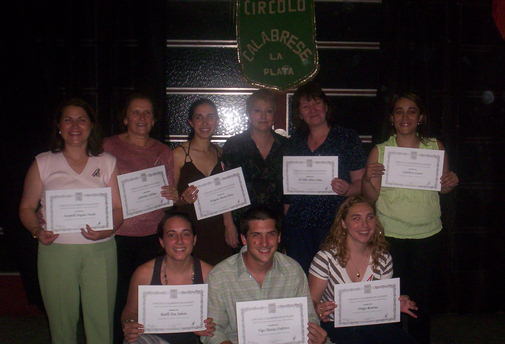
Here are some photos of the Calabrian community in Argentina (click to enlarge):


Source