Western Europe's Attitudes About Immigration

September 29, 2011

These are the results of two recent surveys about immigration conducted in Italy, Spain, France, Britain, Germany and Sweden as part of the Pew Global Attitudes Project.

Italy was the only country of the Western European nations surveyed where a majority viewed the impact of immigrants negatively. Publics in Britain, France, Germany and Spain were divided, while the Swedes had an overwhelmingly positive view of the influence immigrants had on their country.

While the recent anti-immigrant violence has been directed at Africans, Italians expressed equally negative views of immigration from Eastern European countries as they do about immigration from the Middle East and Africa. Two-thirds said it was a bad thing that people from the Middle East and North Africa come to live and work in Italy; an equal number said the same about immigrants from Eastern Europe.

Only about one-in-five Italians saw immigration from the Middle East and Africa and Eastern Europe as a good thing for Italy (20% and 22%, respectively).

Germans were also largely unwelcoming of immigrants. Solid majorities in Germany said it was bad that people from the Middle East and North Africa (64%) and from Eastern Europe (58%) moved to their country.

Opinions were more mixed in Spain and France, while many more in Britain and Sweden said immigration from the Middle East and North African and from Eastern European countries was a good thing than said it was a bad thing.

[...]

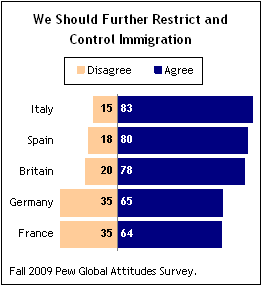
A fall 2009 survey found that more than eight-in-ten Italians (83%) agreed that "we should restrict and control entry into our country more than we do now," including 40% who completely agreed with the statement.

Majorities in the other Western European countries included in the 2009 poll also expressed support for tougher restrictions on immigration. About eight-in-ten in Spain (80%) and Britain (78%) shared that view, as did 65% in Germany and 64% in France.


Juliana Menasce Horowitz. "Widespread Anti-Immigrant Sentiment in Italy". Pew Global Attitudes Project, 2010.

Related: Italians Are Anti-Immigration and Pro-Italy

Men's Hair and Eye Color Preferences

September 7, 2011

The British men surveyed here had a preference for women with brown/black hair (61.7%) and blue/green eyes (57.7%). The remaining 38.3% preferred blond/red hair, and 42.3% preferred brown/hazel eyes. Men in France, Spain, Italy, the U.S. and Brazil were also surveyed, and black was the most popular hair color in all of those countries, while brown and green eyes were preferred.

Badoo, the world's largest Social Network for meeting new people, has polled 2,000 UK males to find the features they find most attractive in the opposite sex. The results have been surprising, with blondes being beaten by brunettes.

In fact a third (33.1%) of all those polled said they find brown hair more attractive than blonde (29.5%), black (28.6%) and red (8.8%), contradicting the adage that gentlemen prefer blondes.

A further surprise the study uncovered is that 38.8% of guys looked for a dress size of 12-14 in their perfect woman, with only 10% looking for a size 6-8. This proves that whilst magazines fill their pages with skinny models, UK males actually prefer a more average build. Only 4.2% preferred size 18+ whilst a curvy size 14-18 was the second most popular with 25.5% of the vote.

Blue eyes still rule the roost in the UK however, with a massive 40.2% of guys preferring blue eyes over brown (29.2%), green (17.5%) and hazel (13.1%).

When all of the pieces of the puzzle are compiled, it's TOWIE's Lauren Goodger who has all of the attributes that men in the UK find most attractive. Her brown hair, blue eyes and average build give her the perfect combination for being the girl next door and the type of girl that UK males find most attractive.

Badoo also ran the study in France, Spain, Italy, US and Brazil and came back with surprising results. In fact only the French said they preferred their women skinny with all others saying they prefer average to curvy women. In all of the countries surveyed, black was the most popular hair colour (except the UK). The UK was also the only country that opted for blue eyes, with brown and green topping the table around the world.

Lloyd Price, from Badoo, said, "I was amazed that blonde hair and size 8 did not top the list. Magazines are full of skinny blonde models, so it is nice to see that in reality guys prefer the girl next door look. Lauren Goodger's boyfriend Mark Wright is clearly a lucky man in the eyes on the nation."

Badoo. "Sorry Marilyn, Gentleman Don't Prefer Blondes Reveals New Study By Badoo.com" [Press Release]. Badoo.com, 22.08.2011.

Devastating Criticism of Richard Lynn

August 1, 2011

Richard Lynn has long been criticized for his controversial studies on intelligence, but this latest series of criticism might just be the final nail in his coffin. Focusing on his much-condemned African IQ studies, it reveals serious flaws in his methodology and calls him out on manipulating and falsifying data, which has wider implications that make his entire body of work (and that of his associates) untrustworthy. It begins with Wicherts et al. 2010:

Although these estimates of national IQ are claimed to be "highly valid" (Rushton, 2003, p. 368) or "credible" (McDaniel, 2008, p. 732) by some authors, the work by Lynn (and Vanhanen) has also drawn criticism (Barnett & Williams, 2004; Ervik, 2003; Hunt & Carlson, 2007; Hunt & Sternberg, 2006; Lane, 1994). One point of critique is that Lynn (and Vanhanen)'s estimate of average IQ among Africans is primarily based on convenience samples, and not on samples carefully selected to be representative of a given, targeted, population (Barnett & Williams, 2004; Hunt & Sternberg, 2006). Unfortunately, in many developing countries, such representative samples are lacking (McDaniel, 2008).

A literature review is necessarily selective. Despite Lynn's objective of providing a "fully comprehensive review of the evidence" (Lynn, 2006, p. 2), a sizeable portion of the relevant literature was not considered in both his own review, and in reviews with Vanhanen. Nowhere in their reviews did Lynn (and Vanhanen) specify the details of their literature search. Our own searches in library databases resulted in additional relevant studies that may be used to estimate national IQ. For instance, Lynn and Vanhanen (2006) accorded a national IQ of 69 to Nigeria on the basis of three samples (Fahrmeier, 1975; Ferron, 1965; Wober, 1969), but they did not consider other relevant published studies that indicated that average IQ in Nigeria is considerably higher than 70 (Maqsud, 1980a,b; Nenty & Dinero, 1981; Okunrotifa, 1976). As Lynn rightly remarked during the 2006 conference of the International Society for Intelligence Research (ISIR), performing a literature review involves making a lot of choices. Nonetheless, an important drawback of Lynn (and Vanhanen)'s reviews of the literature is that they are unsystematic. Unsystematic literature reviews do not adhere to systematic methodology to control for potential biases in the many choices made by the reviewer (Cooper, 1998; Light & Pillemer, 1984). Lynn (and Vanhanen) failed to explicate the inclusion and exclusion criteria they employed in their choice of studies. Such criteria act as a filter, and may thus affect the estimate of national IQ. Lynn (and Vanhanen) excluded data from several sources without providing a rationale. For instance, they used IQ data from Ferron (1965), who provided averages in seven samples of children from Sierra Leone and Nigeria on a little-known IQ test called the Leone. For reasons not given, Lynn (2006) and Lynn and Vanhanen (2006) only used data from the two lowest scoring samples from Nigeria. Most of the remaining samples show higher scores, but those samples were not included in the estimation of the national IQ of Nigeria and Sierra Leone. Likewise, Lynn (and Vanhanen) did not consider several relatively high-scoring African samples from South Africa (Crawford Nutt, 1976; Pons, 1974). It is unfortunate that Lynn (and Vanhanen) did not discuss their exclusion criteria. In some cases (Crawford Nutt, 1976; Pons, 1974), the Raven's Progressive Matrices was administered with additional instruction. Although this instruction is quite similar to an instruction as described in the test manual (Raven, Court, & Raven, 1996), some have argued that this instruction artificially enhances test performance (cf. Rushton & Skuy, 2000). Given the likely differences in opinion on which samples to include or exclude in a review, inclusion and exclusion criteria should be explicated clearly and employed consistently. It is well known that unsystematic literature reviews may lead to biased results (Cooper, 1998; Light & Pillemer, 1984). Another problem is that the computation of statistics in literature reviews is quite error-prone. Indeed Lynn's work contains several errors (Loehlin, 2007).

Lynn responded, attempting to defend his work, and Wicherts et al. fired back immediately with an even stronger rejoinder, repeating their previous criticism of his methodology and flat out accusing him of cherry-picking data that supports his position while ignoring the rest:

In this rejoinder, we criticize Lynn and Meisenberg's (this issue) methods to estimate the average IQ (in terms of British norms after correction of the Flynn Effect) of the Black population of sub-Saharan Africa. We argue that their review of the literature is unsystematic, as it involves the inconsistent use of rules to determine the representativeness and hence selection of samples. Employing independent raters, we determined of each sample whether it was (1) considered representative by the original authors, (2) drawn randomly, (3) based on an explicated stratification scheme, (4) composed of healthy test-takers, and (5) considered by the original authors as normal in terms of Socio-Economic Status (SES). We show that the use of these alternative inclusion criteria would not have affected our results. We found that Lynn and Meisenberg's assessment of the samples' representativeness is not associated with any of the objective sampling characteristics, but rather with the average IQ in the sample. This suggests that Lynn and Meisenberg excluded samples of Africans who average IQs above 75 because they deemed these samples unrepresentative on the basis of the samples' relatively high IQs. We conclude that Lynn and Meisenberg's unsystematic methods are questionable and their results untrustworthy.

Then in a later paper, Wicherts et al. dug even deeper, finding that in addition to picking and choosing, Lynn actively seeks out and uses data that's not reliable or representative:

The samples, considered by Lynn (and Vanhanen), but discarded here, are given in the Appendix. Besides the two samples described above (Klingelhofer, 1967; Zindi, 1994), these are Wober's (1969) sample of factory workers, and Verhaegen's (1956) sample of uneducated adults from a primitive tribe in the then Belgian Congo in the 1950s. Verhaegen indicated that the SPM test format was rather confusing to the test-takers, and that the test did not meet the standards of valid measurement. In Wober's study, the reliability and validity were too low (Wober, 1975). In three of the samples in Table 1, the average IQ is below 70. These are Owen's large sample of Black South African school children tested in the 1980s, the 17 Black South Africans carefully selected for their illiteracy by Sonke (2001), and a group of uneducated Ethiopian Jewish children, who lived isolated from the western world in Ethiopia and immigrated to Israel in the 1980s (Kaniel & Fisherman, 1991). The last two samples cannot be considered to be representative.

[...]

Our review of the literature on the performance of Africans on the Raven's tests showed that the average IQ of Africans on the Raven's tests is lower than the average IQ in western countries. However, the average IQ of Africans is not as low as Lynn (and Vanhanen) and Malloy (2008) maintained. The majority of studies on IQ test performance of Africans not taken into account by Lynn (and Vanhanen) and Malloy showed considerably higher average IQs than the studies that they did review. We judge the reviews of Lynn (and Vanhanen) and Malloy to be unsystematic. These authors missed a large part of the literature on IQ testing in Africa, failed to explicate their inclusion and exclusion criteria, and made downward errors in the conversion of raw scores to IQs (Wicherts, 2007). Lynn (and Vanhanen)'s estimate of average IQ of Africans of around 67 is untenable. Our review indicates that it is about 78 (UK norms) or 80 (US norms). These means are somewhat lower than the means of Africans on other IQ tests, which lie around 82 (Wicherts et al., 2010). These results undermine evolutionary theories of race differences in intelligence of Lynn (2006), Rushton (2000), and Kanazawa (2004) (Wicherts, Borsboom, & Dolan, 2010a; Wicherts et al., 2010b).

Lynn responded to that too, accusing Wicherts et al. of deriving their higher estimate of average African IQ from elite samples, but they once again showed that his lower estimate results from the unsystematic use of samples that are not random or representative.

Greek DNA Sub-Saharan Myth

April 27, 2011

A group of academics have put together a website containing a lengthy article that addresses and thoroughly refutes the infamous Arnaiz-Villena study claiming Greek relatedness to Sub-Saharan Africans, as well as similar studies published by him and others using the same faulty methodology. They're calling for all of the studies to be retracted.

Genetics Studies in the Greek Population vs Pseudoscience


Christos Karatzios, Stephen G. Miller, Costas D. Triantaphyllidis.
January 10, 2011

ABSTRACT:

Arnaiz-Villena et al. published five papers making the claim of a Sub-Saharan African origin for Greeks. Hajjej et al. essentially published copies of Arnaiz-Villena's studies using the same methods, and data sets. World leading geneticists have rejected Arnaiz-Villena's methodology (the primary defect is that they relied on too few genetic markers to reliably compare populations). Numerous studies using proper methodology and multiple genetic markers are presented, showing that Greeks cluster genetically with the rest of the Europeans, disproving Arnaiz-Villena's claims. History, as well as genetics, have been misused by Arnaiz-Villena's (and by extension Hajjej's) unprofessional statements and by their omissions and misquotations of scientific and historical citations. The abuse of scientific methods has earned Arnaiz-Villena's research a citation in a genetics textbook as an example of arbitrary interpretation and a deletion of one of his papers from the scientific literature. In order to protect science from misuse, the related papers of Arnaiz-Villena et al. and Hajjej et al. should also be retracted from the scientific literature.


TABLE OF CONTENTS:

  I. INTRODUCTION

        The Arnaiz-Villena Studies

  II. GENETICS

        Studies that Claim the Opposite

        Arnaiz-Villena Contradicts his Conclusions

        The Studies that Copied Arnaiz-Villena

        Arnaiz-Villena's Faulty Methodology

                i. Single Locus Gene Studies are Inappropriate for Population Genetics

                ii. The Congolese Cluster with the Basques and Icelanders?

        Arnaiz-Villena's Confusing Charts

        Criticism and Rejection by the Scientific Community

                i. The Textbook that Calls it "Arbitrary Interpretation"

                ii. The three Geneticists that Call it "Unreliable and Unacceptable"

                iii. The Retraction

        The Article that Calls it "Scientific Hubris"

        Proper Methodology

        Faulty Methodology, Faulty Studies

        The Curious Omissions

                i. The Japanese appear to cluster with Sub-Saharans

                ii. The Japanese appear to cluster with Africans and Italians

                iii. African genes are present in numerous non-African populations

                iv. Misquoted Data

        Dörk does not support Arnaiz-Villena

        Greeks Cluster Genetically with other Europeans

        The African Origins of all Humans

        Arnaiz-Villena's Answer to his Critics

        Proposed Retractions

  III. HISTORY

        Arnaiz-Villena's Misquotations of Ancient Sources

        Citations of Modern Sources in Support of Inaccuracies

        Inaccurate Statements Without Ancient Documentation

        Contradictory Statements on History

  IV. CONCLUSIONS

  References

Cro-Magnons Were Caucasoid, not Negroid

February 26, 2011

There's a fantasy among Afrocentrists that the first Europeans (Cro-Magnons and other Upper Paleolithic peoples) were totally unlike modern Europeans and instead had affinities with Sub-Saharan Africans. They cite Stringer and McKie (1998) who say that some Cro-Magnons "were more like present-day Australians or Africans", and Brace et al. (2005) who argue against continuity between Upper Paleolithic and later Europeans.

Prehistoric people were still evolving from a more generalized, archaic human morphology, so there's no reason to expect that they be exactly the same as their modern descendants. It's clear enough from the passage following the above quote that Stringer and McKie are not implying Negroid affinities:

It is a confused picture and suggests that racial differences were still developing relatively recently, and should be viewed as a very new part of the human condition. It is an important point, for it shows that humanity's modern African origin does not imply derivation from people like current Africans, because these populations must have also changed through the impact of evolution over the past 100,000 years.

And despite what Brace et al. conclude, their data still groups Cro-Magnon and Upper Paleolithic Europeans (blue) much closer to later and modern Western Eurasians than to Sub-Saharan Africans (red), while they acknowledge that prehistoric populations are distinguished by being "noticeably more robust than more recent human groups":


This robustness that links all prehistoric humans is likely what accounts for most misclassifications and the opinion that there lacks continuity with modern populations. But another factor is the condition of the skulls being analyzed. Jantz and Owsley (2003) found that poorly preserved, highly incomplete Upper Paleolithic crania are often misclassified as African, while those that have a large number of measurements show the expected European affinities:

Some of the discordance Van Vark et al. see between genetic and morphometric results may be attributable to their methodological choices. It is clear that the affiliation expressed by a given skull is not independent of the number of measurements taken from it. From their Table 3, it is evident that those skulls expressing Norse affinity are the most complete and have the highest number of measurements ( = 50.8), while those expressing affinity to African populations (Bushman or Zulu) are the most incomplete, averaging just 16.8 measurements per skull. Use of highly incomplete or reconstructed crania may not yield a good estimate of their morphometric affinities. When one considers only those crania with 40 or more measurements, a majority express European affinity.

To examine this idea further, we use the eight Upper Paleolithic crania available from the test series of Howells (1995), all of which are complete. Our analysis of these eight, based on 55 measurements, is presented in Table 1. Using raw measurements, 6 of 8 express an affinity to Norse, and with the shape variables of Darroch and Mosimann (1985), 5 of 8 express a similarity to Norse. Using shape variables reduces the Mahalanobis distance, substantially in some cases. Typicality probabilities, particularly for the shape variables, show the crania to be fairly typical of recent populations. The results presented in Table 1 are consistent with the idea that Upper Paleolithic crania are, for the most part, larger and more generalized versions of recent Europeans. Howells (1995) reached a similar conclusion with respect to European Mesolithic crania.

That seems to be the general consensus, and Howells (1997) just comes right out and says it without mincing any words:

If Upper Paleolithic people were "European" from about 35,000 B.P., then such population distinctions are at least that old. And the Cro-Magnons were already racially European, i.e., Caucasoid. This has always been accepted because of the general appearance of the skulls: straight faces, narrow noses, and so forth. It is also possible to test this arithmetically. [...] Except for Predmosti 4, which is distant from every present and past population, all of these skulls show themselves to be closer to "Europeans" than to other peoples — Mladec and Abri Pataud comfortably so, the other two much more remotely.

Effects of Climate on European History

February 1, 2011

A new study of temperature and precipitation levels over the past 2500 years shows that periods of prosperity and decline throughout European history correlate with environmental changes affecting agriculture, health and conflict. This should give pause to those who still subscribe to old "racialist" theories based on superiority and miscegenation.

2500 Years of European Climate Variability and Human Susceptibility


Ulf Büntgen et al. (2011)
Science

Climate variations have influenced the agricultural productivity, health risk, and conflict level of preindustrial societies. Discrimination between environmental and anthropogenic impacts on past civilizations, however, remains difficult because of the paucity of high-resolution palaeoclimatic evidence. Here, we present tree ring-based reconstructions of Central European summer precipitation and temperature variability over the past 2500 years. Recent warming is unprecedented, but modern hydroclimatic variations may have at times been exceeded in magnitude and duration. Wet and warm summers occurred during periods of Roman and medieval prosperity. Increased climate variability from ~AD 250 to 600 coincided with the demise of the Western Roman Empire and the turmoil of the Migration Period. Historical circumstances may challenge recent political and fiscal reluctance to mitigate projected climate change.

[...]

AMJ [April-June] precipitation was generally above average and fluctuated within fairly narrow margins from the Late Iron Age through most of the Roman Period until ~AD 250, whereas two depressions in JJA [June-August] temperature coincided with the Celtic Expansion ~350 BC and the Roman Conquest ~50 BC. Exceptional climate variability is reconstructed for AD ~250-550, and coincides with some of the most severe challenges in Europe's political, social and economic history, the MP [Migration Period]. Distinct drying in the 3rd century paralleled a period of serious crisis in the WRE [Western Roman Empire] marked by barbarian invasion, political turmoil and economic dislocation in several provinces of Gaul, including Belgica, Germania superior and Rhaetia. Precipitation increased during the recovery of the WRE in the 300s under the dynasties of Constantine and Valentinian, while temperatures were below average. Precipitation surpassed early imperial levels during the demise of the WRE in the 5th century before dropping sharply in the first half of the 6th century. At the same time, falling lake levels in Europe and Africa accompanied hemispheric-scale cooling that has been linked with an explosive, near equatorial volcanic eruption in AD 536, followed by the first pandemic of Justinian plague that spread from the Eastern Mediterranean in AD 542/543. Rapid climate changes together with frequent epidemics had the overall capacity to disrupt the food production of agrarian societies. Most of the oak samples from this period originate from archaeological excavations of water wells and sub-fossil remains currently located in floodplains and wetlands, possibly attesting drier conditions during their colonization.

AMJ precipitation and JJA temperature began to increase from the end of the 6th century and reached climate conditions comparable to those of the Roman period in the early 800s. The onset of wetter and warmer summers is contemporaneous with the societal consolidation of new kingdoms that developed in the former WRE. Reduced climate variability from ~AD 700-1000, relative to its surroundings, matches the new and sustained demographic growth in the northwest European countryside, and even the establishment of Norse colonies in the cold environments of Iceland and Greenland. Humid and mild summers paralleled the rapid cultural and political growth of medieval Europe under the Merovingian and Carolingian dynasties and their successors. Average precipitation and temperature showed fewer fluctuations during the ~AD 1000-1200 period of peak medieval demographic and economic growth. Wetter summers during the 13th and 14th centuries and a first cold spell ~1300 agree with the globally observed onset of the Little Ice Age, likely contributing to widespread famine across CE [Central Europe]. Unfavorable climate may have even played a role in debilitating the underlying health conditions that contributed to the devastating economic crisis that arose from the second plague pandemic, the Black Death, which reduced the CE population after AD 1347 by 40-60%. The period is also associated with a temperature decline in the North Atlantic and the abrupt desertion of former Greenland settlements. Temperature minima in the early 17th and 19th centuries accompanied sustained settlement abandonment during the Thirty Years' War and the modern migrations from Europe to America.


Fig. 4. Reconstructed AMJ precipitation totals (Top) and JJA temperature anomalies (Bottom) (wrt 1901-2000). Error bars are +/− 1 RMSE of the calibration periods. Black lines show independent precipitation and temperature reconstructions from Germany and Switzerland. Bold lines are 60-year low-pass filters. Periods of demographic expansion, economic prosperity and societal stability, as well as political turmoil, cultural change and population instability are marked (green and grey text).

Link (PDF)

Coon's Work Remains Valuable

January 11, 2011

Those who dislike the findings and racial classifications of early anthropologist Carleton S. Coon will try to write him off as outdated, argue that his research is superficial, or that all of his data should be thrown out because some of his theories were wrong. An appreciation written a few years after his death by a modern anthropologist disproves these claims and affirms the continuing value and influence of his work. It also shows that he was already dealing with the kind of unscientific race-denial that's so rampant today, and defending himself against the accusations of "racism" that go with it.

An enormous intellectual vigor allowed him to follow up hypotheses without becoming wedded to them. Never a writer of small papers, he looked for the larger significance. It may be said that Coon's major contributions to science were the fruitful formulations that followed from his assimilation and organization of massive amounts of information.

PHYSICAL ANTHROPOLOGY: RACIAL ADAPTATIONS

Carleton Coon's The Races of Europe (1939) began as a revision of W. Z. Ripley's 1900 work but ended as a new opus that used every scrap of published information on living populations and prehistoric human remains — and much recorded history besides. Though some of Coon's hypotheses seem dubious today, they allowed him to structure a mass of material in a way that remains impressive. This book was reprinted some years later and is still regarded as a valuable source of data.

[...]

Coon's desire was to use Darwinian adaptation to explain the physical characteristics of race. He defined these as the physical features that distinguish modern populations and in 1950 published, with S. M. Garn and J. B. Birdsell, Races: A Study of the Problems of Race Formation in Man. He was exasperated by what he called the "hide-race" attitude of people who, from social or philosophical motives, seemed to deny the existence of obvious biological differences. He became indignant at any suggestion that his interest in race derived from racist motives. Although a good many articles had been written about environmental adaptation of such traits, this book was the first to address the problem as a whole.

[...]

After holding several serious ailments at bay for some years, Carl died on June 3, 1981, at his West Gloucester home, shortly before his seventy-seventh birthday. His brilliance left a lasting mark on a generation of anthropologists.

W. W. Howells. "Biographical Memoirs V.58". National Academy of Sciences, 1989.

Carthaginian Reconstruction

October 30, 2010

Science and art bring young Carthaginian 'back to life'


By Kaouther Larbi
Agence France Presse
Oct. 28, 2010

CARTHAGE, Tunisia (AFP) — Clad in a white linen tunic, sandals in the ancient Carthaginian style and a pendant and beads like those found with his remains, 2,500-year-old "Ariche" has virtually come back to life on the sacred hill of Byrsa where he was born.

The outcome of scientific cooperation between France and Tunisia, the young man has been remodelled and returned to his native soil in historical Carthage, a city state that lasted from 814 B.C. to 146 B.C. He will be given a place of honour in the museum of modern-day Carthage, north of Tunis.

"The distance that separates the centuries has been erased, the bones are given flesh and the eyes light up anew in a young man who lived right here six centuries before our own era," French ambassador Pierre Menat said at the opening of the exhibition last week.

The modern history of the youth of Byrsa began in 1994 with the fortuitous discovery of a sepulchre on the southern flank of the hill, which is one of the most famous sites of antique Carthage. A joint Franco-Tunisian team moved in to excavate.

"Gone too soon, taken prematurely from life and the love of those close to him (...) he was doubtless of noble birth and his body was buried in this generous African soil," said Leila Sebai, president of the International Council of Museums and commissioner of the exhibition.

An anthropological study of the skeleton showed that the man died between the age of 19 and 24, had a pretty robust physique and was 1.7 metres (five feet six inches) tall, according to a description by Jean Paul Morel, director of the French archaeological team at Carthage Byrsa.

The man from Byrsa has been rebaptised Ariche — meaning the desired man — at the initiative of Culture Minister Abderraouf Basti, who inaugurated the exhibition.

Ariche has regained an almost living human appearance very close in physiognomy to a Carthaginian of the 6th century B.C. after a dermoplastic reconstruction undertaken in Paris by Elisabeth Daynes, a sculptor specialising in hyper-realistic reconstructions.

"He comes back to us thanks to scientific rigour, notably that of paleo-anthropology and forensic medicine, but also the magic of art, that of Elisabeth Daynes, who knows how to bring many faces back from the distant past," Sebai said.

Dermoplastic reconstruction is based on a scientific technique that enables experts to restore the features of an individual with 95 percent accuracy, though some aspects, such as the colour of the eyes and the hair remain partially subjective, she added.

"We can clearly see that this exceptional witness to Carthage in the Punic era is a Mediterranean man, he has all the characteristics," noted Sihem Roudesli, a paleo-anthropologist at the Tunisian National Heritage Institute.

"I hope that like his contemporaries, legendary sailors and bringers of civilisation, this young man can travel across the seas to bear witness on other continents to the greatness of Carthage," Menat said.

Repatriated on September 24, Ariche will be on show at Byrsa until the end of March 2011 when he will travel to Lebanon, the land of the Phoenicians who founded Carthage, for an exhibition at the American University of Beirut.

Link

Oldest Negroid Skull?

September 30, 2010

I had previously posted that the 6500-year-old Asselar skeleton discovered in Mali was the earliest example of a Negroid African. But it turns out there's a slightly older skull with Negroid features from farther south in West Africa (Iwo Eleru, Nigeria) that seems to be a much better candidate.

Mauny, 1978:

The oldest-known skeleton of a West African was found in Nigeria at Iwo Eleru; it is of a negroid man and is dated to 9250 ± 150 BC.

Allsworth-Jones, 2002:

A human burial described as "proto-Negroid" was found at the base of the succession at Iwo Eleru with a date of 11200 ± 200 BP.

Phillipson, 2005:

A single human skeleton some 12,000 years old from the lowest level of Iwo Eleru has been described as already showing specifically negroid features....

Note that there have been other candidates for the oldest Negroid skull, but in East rather than West Africa, such as Nazlet Khater (33,000 B.P., Upper Egypt) and Jebel Sahaba or Wadi Halfa (Mesolithic Nubia). However, these are very contentious and in all likelihood not Negroid, given that East Africans were still non-Negroid until much more recently.

Italianthro: Italian Anthropology Blog

September 9, 2010

I'm launching a new side project focusing on the biological and social anthropology of Italy and Italian people. At first, I'll be copying some of my old Italy-related posts from here, and occasionally after that I may cross-post material on both blogs. But mostly, the new blog will delve more deeply into the subject than would be appropriate for the broader scope of this blog.

Here's the URL: http://italianthro.blogspot.com/