Collection of photo series depicting people of different races and ethnicities from various walks of life. In each series, concerted effort has been made to exclude individuals with backgrounds other than that stated. Corrections and suggestions are welcome.
http://racialreality.shorturl.com/gallery.html
I hope to add more galleries in the future. If anyone has any ideas (and more importantly picture sources), leave a comment or drop me a line.

Study Clarification IV
January 27, 2006
Here's the latest paper being paraded around by Nordicists and Afrocentrists, who, as usual, haven't bothered to look beyond a couple of passages they find favorable.
Study:
Calo et al. (2003)
Hum Biol
Link to Full Text
Misused Quotes:
Clarification:
To begin with, most of the research cited in parentheses is from the 60s, 70s, 80s and early 90s, and based on antiquated methods of analyzing blood groups that are now known to be under selective pressure, like HbS, Fy(a-b-) and cDe. A problematic Semino paper is also cited, and two references are even surname analyses pertaining to "economic boundaries," which have nothing to do with genetics at all. Needless to say, none of this is reliable evidence for anything.
Despite the claims of Arab and black admixture being detected in the present data, no Middle Eastern or sub-Saharan African populations are sampled in the study — only two North African populations and other Europeans were tested. The neighbor joining tree (unfortunately not reproduced) is said to group the Sicilian samples on one side with Egyptians among them, and the western/central European samples on the other side with Moroccans among them. The best explanation for this arrangement is the known divide between the eastern and western Mediterranean in terms of Neolithic ancestry, which affects both the European and African coasts and runs vertically through Italy, dividing north from south.
However, the authors use this inconclusive Sicilian-Egyptian connection anyway, and for double duty. First they imply that it serves as evidence of Arab admixture, which is problematic in itself because Egyptians are not particularly good representatives of Arabs. Then in the very next paragraph, they say it confirms the earlier findings of Semino and Sandler alleging African admixture. But Egyptians are North African Caucasoids, while both of those studies deal with markers prevalent in Negroids from sub-Saharan Africa. So in the span of two paragraphs, the authors jump from "Arabs" to "Egyptians" to "North Africans" to "Africans" to "black slaves" and then back to "Arab immigrants," as if these were all synonymous. Very sloppy.
Finally, all of these supposed foreign influences in Sicily are only referred to vaguely using qualifiers and indefinite language like "seems" and "a certain degree." The adjective "strong" is used once, but we know from past experience how a word like that can be an exaggeration that actually amounts to very little admixture. So even if we were to accept the authors' outdated references and ludicrous interpretations, they would have to be taken with a grain of salt for that reason alone.
Study:
Genetic analysis of a Sicilian population using 15 short tandem repeats
Calo et al. (2003)
Hum Biol
Link to Full Text
Misused Quotes:
Other authors, studying classical markers (Piazza et al. 1988; Cavalli-Sforza and Edwards 1969) and surnames (Guglielmino et al. 1991), have stressed the existence of genetic differentiation between the eastern and western areas of Sicily and, in general, a remarkable internal variation. In addition, the boundaries found within the Palermo district have been stressed as a sort of economic boundary in a study focusing on surnames (Zei et al. 1993). The variability that has been found could be a consequence of the various dominations that Sicily has undergone: Sycanians, Siculi, and Elymians to begin with (Piazza et al. 1988), followed by Greeks, Romans, Normans, and Arabs (Sandier et al. 1978; Beretta et al. 1986). Among these, Arab domination seems to have had a very strong genetic impact.
[...]
Further analysis shows within the same cluster a certain degree of affinity between Egypt and the populations of Sicily. The relationship between Sicilian and North African populations is controversial in population genetics (Piazza et al. 1988; Rickards et al. 1992; Rickards et al. 1998). Our data seem to confirm the hypothesis of Sandler et al. (1978) that underlines the African contribution to the Sicilian gene pool, because of the high frequencies of Hbs, cDe, and Fy (a-b-). In a paper on mtDNA, Semino et al. (1989) found support for this hypothesis, dating back to the introduction of black slaves by Phoenicians and Romans and to the later influxes of Arab immigrants.
[...]
A genetic boundary, in fact, clearly divides Sicily from north-central Italy and from northern European populations, besides the other populations from the western Mediterranean basin.
Clarification:
To begin with, most of the research cited in parentheses is from the 60s, 70s, 80s and early 90s, and based on antiquated methods of analyzing blood groups that are now known to be under selective pressure, like HbS, Fy(a-b-) and cDe. A problematic Semino paper is also cited, and two references are even surname analyses pertaining to "economic boundaries," which have nothing to do with genetics at all. Needless to say, none of this is reliable evidence for anything.
Despite the claims of Arab and black admixture being detected in the present data, no Middle Eastern or sub-Saharan African populations are sampled in the study — only two North African populations and other Europeans were tested. The neighbor joining tree (unfortunately not reproduced) is said to group the Sicilian samples on one side with Egyptians among them, and the western/central European samples on the other side with Moroccans among them. The best explanation for this arrangement is the known divide between the eastern and western Mediterranean in terms of Neolithic ancestry, which affects both the European and African coasts and runs vertically through Italy, dividing north from south.
However, the authors use this inconclusive Sicilian-Egyptian connection anyway, and for double duty. First they imply that it serves as evidence of Arab admixture, which is problematic in itself because Egyptians are not particularly good representatives of Arabs. Then in the very next paragraph, they say it confirms the earlier findings of Semino and Sandler alleging African admixture. But Egyptians are North African Caucasoids, while both of those studies deal with markers prevalent in Negroids from sub-Saharan Africa. So in the span of two paragraphs, the authors jump from "Arabs" to "Egyptians" to "North Africans" to "Africans" to "black slaves" and then back to "Arab immigrants," as if these were all synonymous. Very sloppy.
Finally, all of these supposed foreign influences in Sicily are only referred to vaguely using qualifiers and indefinite language like "seems" and "a certain degree." The adjective "strong" is used once, but we know from past experience how a word like that can be an exaggeration that actually amounts to very little admixture. So even if we were to accept the authors' outdated references and ludicrous interpretations, they would have to be taken with a grain of salt for that reason alone.
Skin Reflectance of Selected World Populations
January 9, 2006
All samples are composed of indigenous populations, and readings are taken on areas of the body not exposed to the sun. Higher values indicate lighter skin, and lower values darker skin.
Jablonski and Chaplin. "The Evolution of Human Skin Coloration". J Hum Evol, 2000.
Country and population or area |
Observed reflectance at 685 nm |
|---|---|
| EUROPE | |
| Netherlands | 67•37 |
| Germany (Mainz) | 66•90 |
| United Kingdom (Northern) | 66•10 |
| Spain (Basques) | 65•70 |
| United Kingdom (Wales) | 65•00 |
| Ireland (Rossmore) | 64•75 |
| Spain (Leon) | 64•66 |
| Belgium | 63•14 |
| United Kingdom (London) | 62•30 |
| WEST ASIA | |
| Iraq/Syria (Kurds) | 61•12 |
| Turkey | 59•15 |
| Israel | 58•20 |
| Lebanon | 58•20 |
| Jordan | 53•00 |
| Saudi Arabia | 52•50 |
| NORTH AFRICA | |
| Algeria (Aures) | 58•05 |
| Tunisia | 56•30 |
| Morrocco | 54•85 |
| Libya (Tripoli) | 54•40 |
| Libya (Fezzan) | 44•00 |
| SOUTH ASIA | |
| India (Northern) | 53•26 |
| Pakistan | 52•30 |
| India (Southern) | 46•70 |
| EAST ASIA | |
| China (Southern) | 59•17 |
| Vietnam | 55•90 |
| Japan (Northern) | 54•90 |
| Philippines (Manila) | 54•10 |
| Cambodia | 54•00 |
| Japan (Southwest) | 53•55 |
| Nepal (Eastern) | 50•42 |
| AUSTRO-MELANESIA | |
| Papua New Guinea | 35•30 |
| Australia (Darwin) | 19•30 |
| AMERICAS | |
| Greenland (Southern) | 55•70 |
| Peru (Nunoa) | 47•70 |
| Peru (Maranon) | 43•05 |
| SUB-SAHARAN AFRICA | |
| South Africa (Hottentot) | 46•80 |
| Botswana (San) | 42•40 |
| Zaire | 33•20 |
| Kenya | 32•40 |
| Ethiopia | 31•70 |
| Tanzania (Sandewe) | 28•90 |
| Namibia | 25•55 |
| Cameroon (Fali) | 21•50 |
| Mozambique (Chopi) | 19•45 |
Jablonski and Chaplin. "The Evolution of Human Skin Coloration". J Hum Evol, 2000.
Original Pigmentation of Hominids
January 3, 2006
What skin color was primitive for the hominid lineage?
Before questions about changes in integumentary pigmentation in modern human evolution can be addressed, consideration must be given to the probable primitive condition of the integument in the earliest members of the human lineage. It is likely that the integument of the earliest protohominids was similar to that of our closest living relative, the chimpanzee, being white or lightly pigmented and covered with dark hair (Post et al., 1975b). In the chimpanzee, exposed areas of skin vary considerably in their coloration depending on the species and subspecies under consideration, but in all groups facial pigmentation increases with age and exposure to UV radiation (Post et al., 1975b). Except for the face, eyelids, lips, pinnae, friction surfaces, and anogenital areas, the epidermis of most nonhuman primates is unpigmented due to an absence of active melanocytes (Montagna & Machida, 1966; Montagna et al., 1966a,b), suggesting that this is the primitive condition for primates in general. The hairless areas listed above are pigmented to greater or lesser extents in all primate species (Montagna & Machida, 1966; Montagna et al., 1966a,b), suggesting that the potential for induction of melanogenesis (Erickson & Montagna, 1975) in exposed skin is also primitive for the group.
Physiological models have demonstrated that the evolution of hairlessness and an essentially modern sweating mechanism were coordinated with the higher activity levels associated with the modern limb proportions and striding bipedalism (Montagna, 1981; Schwartz & Rosenblum, 1981; Wheeler, 1984, 1996; Chaplin et al., 1994). Throughout this transitional period, the critical function of the integument in thermoregulation was maintained through evolution of an increased number of sweat glands, particularly on the face (Cabanac & Caputa, 1979; Falk, 1990), that increased the maximum rate of evaporative cooling available at any one time (Wheeler, 1996; see also Mahoney, 1980). The brain is extremely heat sensitive, and its temperature closely follows arterial temperature (Nelson & Nunneley, 1998). Evolution of a whole-body cooling mechanism capable of finely regulating arterial temperature was, therefore, a prerequisite for brain expansion and increased activity levels. Naked skin itself affords a thermoregulatory advantage because it makes for a reduced total thermal load requiring evaporative dissipation (Wheeler, 1996). As the density of body hair decreased and the density of sweat glands increased, the need for protection of subepidermal tissues against the destructive effects of UV radiation, particularly UVB, also increased. This protection was accomplished by an increase in melanization of the skin.
Jablonski and Chaplin. "The Evolution of Human Skin Coloration". J Hum Evol, 2000.
AAA Statement on Race
December 7, 2005
In 1998, the American Anthropological Association issued an official statement declaring that clearly demarcated, biological races don't exist, which is supposed to represent "the contemporary thinking and scholarly positions of a majority of anthropologists". This irresponsible exercise in PC pandering is constantly cited by uninformed people looking to discredit the reality of race.
Here are the three main flaws with the statement:
1) All but the first two paragraphs discuss social aspects of race (i.e. racism), going into detail about racial pseudo-theories and discrimination from colonial times to the Holocaust. It's interesting but it doesn't belong in a statement regarding the scientific aspects of race.
2) The brief paragraph that actually deals with anthropology emphasizes the overlapping across biological populations of single, adaptive traits like skin color and hair form, but it makes no mention whatsoever of skeletal structure and its uses in determining racial affinity in the field of forensic anthropology.
3) The other scientifically oriented paragraph delves into population genetics (not the AAA's field) to argue that large within-group variation renders any between-group variation meaningless. This may have seemed true back in the 70s when the field was still in its infancy, but today it's rejected as Lewontin's fallacy:
Here's a collection of recent genetic studies that have identified racial clusters:
Here are the three main flaws with the statement:
1) All but the first two paragraphs discuss social aspects of race (i.e. racism), going into detail about racial pseudo-theories and discrimination from colonial times to the Holocaust. It's interesting but it doesn't belong in a statement regarding the scientific aspects of race.
2) The brief paragraph that actually deals with anthropology emphasizes the overlapping across biological populations of single, adaptive traits like skin color and hair form, but it makes no mention whatsoever of skeletal structure and its uses in determining racial affinity in the field of forensic anthropology.
3) The other scientifically oriented paragraph delves into population genetics (not the AAA's field) to argue that large within-group variation renders any between-group variation meaningless. This may have seemed true back in the 70s when the field was still in its infancy, but today it's rejected as Lewontin's fallacy:
In popular articles that play down the genetical differences among human populations, it is often stated that about 85% of the total genetical variation is due to individual differences within populations and only 15% to differences between populations or ethnic groups. It has therefore been proposed that the division of Homo sapiens into these groups is not justified by the genetic data. This conclusion, due to R.C. Lewontin in 1972, is unwarranted because the argument ignores the fact that most of the information that distinguishes populations is hidden in the correlation structure of the data and not simply in the variation of the individual factors.
[...]
There is nothing wrong with Lewontin's statistical analysis of variation, only with the belief that it is relevant to classification. It is not true that "racial classification is...of virtually no genetic or taxonomic significance". It is not true, as Nature claimed, that "two random individuals from any one group are almost as different as any two random individuals from the entire world", and it is not true, as the New Scientist claimed, that "two individuals are different because they are individuals, not because they belong to different races" and that "you can't predict someone's race by their genes". Such statements might only be true if all the characters studied were independent, which they are not.
[...]
This article could, and perhaps should, have been written soon after 1974. Since then many advances have been made in both gene technology and statistical computing that have facilitated the study of population differences from genetic data. The magisterial book of Cavalli-Sforza, Menozzi and Piazza (13) took the human story up to 1994, and since then many studies have amply confirmed the validity of the approach. Very recent studies (14,15) have treated individuals in the same way that Cavalli-Sforza and Edwards treated populations in 1963, namely by subjecting their genetic information to a cluster analysis thus revealing genetic affinities that have unsurprising geographic, linguistic and cultural parallels. As the authors of the most extensive of these (15) comment, "it was only in the accumulation of small allele-frequency differences across many loci that population structure was identified."
Here's a collection of recent genetic studies that have identified racial clusters:
Caucasoid Affinities of Somalis
November 20, 2005
It's been well documented that Ethiopians share a substantial amount of their ancestry with Western Eurasians (Caucasoids), but less talked about is the similar position of Somalis.

Brace et al. "Clines and clusters versus 'Race:' a test in ancient Egypt and the case of a death on the Nile". Am J Phys Anthro, 1993.

Tishkoff et al. "Short Tandem-Repeat Polymorphism/Alu Haplotype Variation at the PLAT Locus: Implications for Modern Human Origins". Am J Hum Genet, 2000.


Anthropology
When the nonadaptive aspects of craniofacial configuration are the basis for assessment, the Somalis cluster with Europeans before showing a tie with the people of West Africa or the Congo Basin.
[...]
As our data show, the people of the Horn of Africa are craniofacially less distinct from a spectrum of samples marginally including South Asia and running all the way from the Middle East to northwest Europe than they are to any group in sub-Saharan Africa.

Brace et al. "Clines and clusters versus 'Race:' a test in ancient Egypt and the case of a death on the Nile". Am J Phys Anthro, 1993.
Genetics
The most distinct separation is between African and non-African populations. The northeastern-African — that is, the Ethiopian and Somali — populations are located centrally between sub-Saharan African and non-African populations.
[...]
The fact that the Ethiopians and Somalis have a subset of the sub-Saharan African haplotype diversity — and that the non-African populations have a subset of the diversity present in Ethiopians and Somalis — makes simple-admixture models less likely; rather, these observations support the hypothesis proposed by other nuclear-genetic studies (Tishkoff et al. 1996a, 1998a, 1998b; Kidd et al. 1998) — that populations in northeastern Africa may have diverged from those in the rest of sub-Saharan Africa early in the history of modern African populations and that a subset of this northeastern-African population migrated out of Africa and populated the rest of the globe.
+ 13 = Somalis
• 1-7 = Sub-Saharan Africans (Negroid)
• 8-11 = Sub-Saharan Africans (Khoisanid)
Δ 22-25 = Caucasoids (N. Europe and Mid-East)
Tishkoff et al. "Short Tandem-Repeat Polymorphism/Alu Haplotype Variation at the PLAT Locus: Implications for Modern Human Origins". Am J Hum Genet, 2000.
Racial Types


'Star Wars' Stereotypes
November 12, 2005
Amusing Flash page parodying the ethnically questionable characters from the most recent Star Wars trilogy:
http://www.flakmag.com/flash/swdvd.html
http://www.flakmag.com/flash/swdvd.html
Most Violent Countries
September 21, 2005
Scotland tops list of world's most violent countries
By Katrina Tweedie
Times Online
September 19, 2005
A UNITED Nations report has labelled Scotland the most violent country in the developed world, with people three times more likely to be assaulted than in America.
England and Wales recorded the second highest number of violent assaults while Northern Ireland recorded the fewest.
The study, based on telephone interviews with victims of crime in 21 countries, found that more than 2,000 Scots were attacked every week, almost ten times the official police figures. They include non-sexual crimes of violence and serious assaults.
Violent crime has doubled in Scotland over the past 20 years and levels, per head of population, are now comparable with cities such as Rio de Janeiro, Johannesburg and Tbilisi.
The attacks have been fuelled by a "booze and blades" culture in the west of Scotland which has claimed more than 160 lives over the past five years. Since January there have been 13 murders, 145 attempted murders and 1,100 serious assaults involving knives in the west of Scotland. The problem is made worse by sectarian violence, with hospitals reporting higher admissions following Old Firm matches.
David Ritchie, an accident and emergency consultant at Glasgow's Victoria Infirmary, said that the figures were a national disgrace. "I am embarrassed as a Scot that we are seeing this level of violence. Politicians must do something about this problem. This is a serious public health issue. Violence is a cancer in this part of the world," he said.
Detective Chief Superintendent John Carnochan, head of the Strathclyde Police's violence reduction unit, said the problem was chronic and restricting access to drink and limiting the sale of knives would at least reduce the problem.
The study, by the UN's crime research institute, found that 3 per cent of Scots had been victims of assault compared with 1.2 per cent in America and just 0.1 per cent in Japan, 0.2 per cent in Italy and 0.8 per cent in Austria. In England and Wales the figure was 2.8 per cent.
Scotland was eighth for total crime, 13th for property crime, 12th for robbery and 14th for sexual assault. New Zealand had the most property crimes and sexual assaults, while Poland had the most robberies.
Chief Constable Peter Wilson, president of the Association of Chief Police Officers in Scotland, questioned the figures. "It must be near impossible to compare assault figures from one country to the next based on phone calls," he said.
"We have been doing extensive research into violent crime in Scotland for some years now and this has shown that in the vast majority of cases, victims of violent crime are known to each other. We do accept, however, that, despite your chances of being a victim of assault being low in Scotland, a problem does exist."
Link
Argentinean Italians Are Mostly Southern
September 9, 2005
Migration from Southern Italy to Argentina: Calabrians and Sicilians (1880-1930)
Cacopardo et al. (1990)
Studi Emigr
ABSTRACT: The study analyzes Italian emigration to Argentina from Sicily and Calabria between 1880-1930, compared with out-migration flows from Piedmont. The concepts of cultural patrimony and of migratory strategy are used to measure the different potentials and job opportunities in the Argentinean labor market as well as in the Italian context for those returning home. Considering the high proportion of returnees, a positive or negative correlation between region of origin and of destination can be proposed. Southern Italians indicate a more permanent settlement. The authors conclude that the Argentinean society in its Italian component is the result of Southern rather than Northern influences.
Link
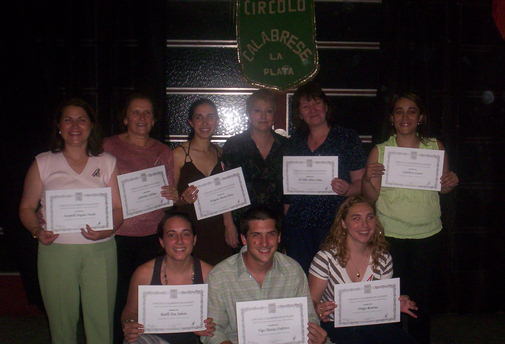
Here are some photos of the Calabrian community in Argentina (click to enlarge):




Source
More on the King Tut Reconstructions
September 1, 2005
We've seen the recent French reconstruction of King Tut. Now let's compare it to the Egyptian and American ones done at the same time, the latter with no prior knowledge of the race or identity of the individual being reconstructed. They're the first ever Tut reconstructions based on CT scans of his mummy, and therefore considered to be the most accurate to date.
Egyptologist Dr. Zahi Hawass notes that "The results of the three teams were identical or very similar in the basic shape of the face, the size, shape and setting of the eyes, and the proportion of the skull." All three teams identify Tut as a Caucasoid North African, and Hawass remarks on the striking resemblance their models bear to ancient portraits of the boy pharaoh.
[ click images to enlarge ]


French Reconstruction


Egyptian Reconstruction


American "Blind" Reconstruction
French:
- Jean-Noël Vignal, forensic expert, Institut de Recherche Criminelle de la Gendarmerie Nationale, Paris
- Elisabeth Daynes, anthropological sculptor, Atelier Daynes, Paris
Egyptian:
- Khaled Elsaid, biomedical engineer and team leader
American:
- Susan Antón, physical anthropologist, New York University, New York City
- Michael Anderson, forensic sculptor, Yale Peabody Museum, New Haven, Connecticut
Egyptologist Dr. Zahi Hawass notes that "The results of the three teams were identical or very similar in the basic shape of the face, the size, shape and setting of the eyes, and the proportion of the skull." All three teams identify Tut as a Caucasoid North African, and Hawass remarks on the striking resemblance their models bear to ancient portraits of the boy pharaoh.


French Reconstruction


Egyptian Reconstruction


American "Blind" Reconstruction
RECONSTRUCTION TEAMS
French:
- Jean-Noël Vignal, forensic expert, Institut de Recherche Criminelle de la Gendarmerie Nationale, Paris
- Elisabeth Daynes, anthropological sculptor, Atelier Daynes, Paris
Egyptian:
- Khaled Elsaid, biomedical engineer and team leader
American:
- Susan Antón, physical anthropologist, New York University, New York City
- Michael Anderson, forensic sculptor, Yale Peabody Museum, New Haven, Connecticut
Subscribe to:
Posts (Atom)